

Rolex Explorer ref. 214270
The evolution of the Rolex Explorer
The Rolex Explorer is the brand's most understated sports watch, often flying under the radar. However, with its rich history and very wearable look, the Explorer is a Rolex watch that shouldn't be overlooked.
The Explorer's official story famously takes shape with Sir Edmund
Hillary and Tenzing Norgay's pioneering ascent to Mount Everest in 1953.
To commemorate the feat — and to remind people that Rolex Oyster
Perpetual watches were worn during that expedition — Rolex released the
Oyster Perpetual Explorer that same year.
The Explorer story continues to today and here we take a look at four key references dating back from an early Explorer ref. 6610 to the current Explorer ref. 214270 and some in between to examine the model's beginnings, evolution, and present-day status.
Rolex Explorer ref. 6610
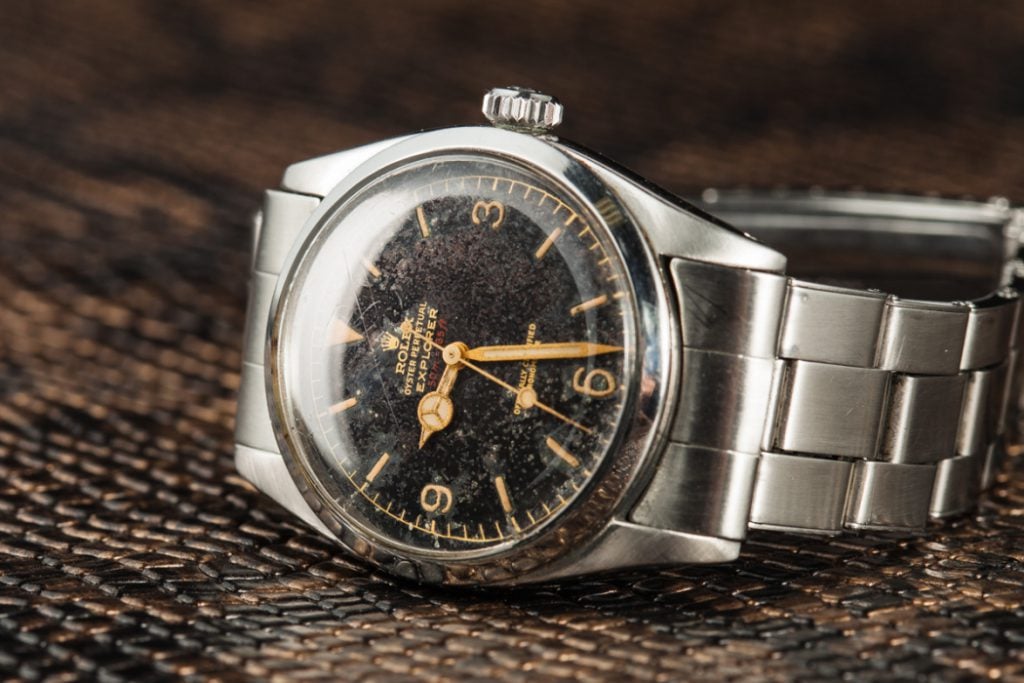
Rolex Explorer ref. 6610
The Rolex Explorer ref. 6610 was first presented in 1959 as the replacement of the Explorer ref. 6150. It features a stainless steel Oyster case measuring 36mm in diameter and a black gilt dial.
On the dial we see the upside down triangle, baton hour markers, and
3,6, and 9 numerals configuration that is still characteristic of the
Rolex Explorer today. The Mercedes-style hands on the vintage Explorer ref. 6610 is also something we see on contemporary versions of the Explorer.
Something interesting on note on this particular example is the
waterproof indication (50m) printed in red right under the “EXPLORER”
label. As an early version of the Explorer with a short production span, the ref. 6610 is a rare example of a vintage Rolex watch.
Rolex Explorer ref. 1016
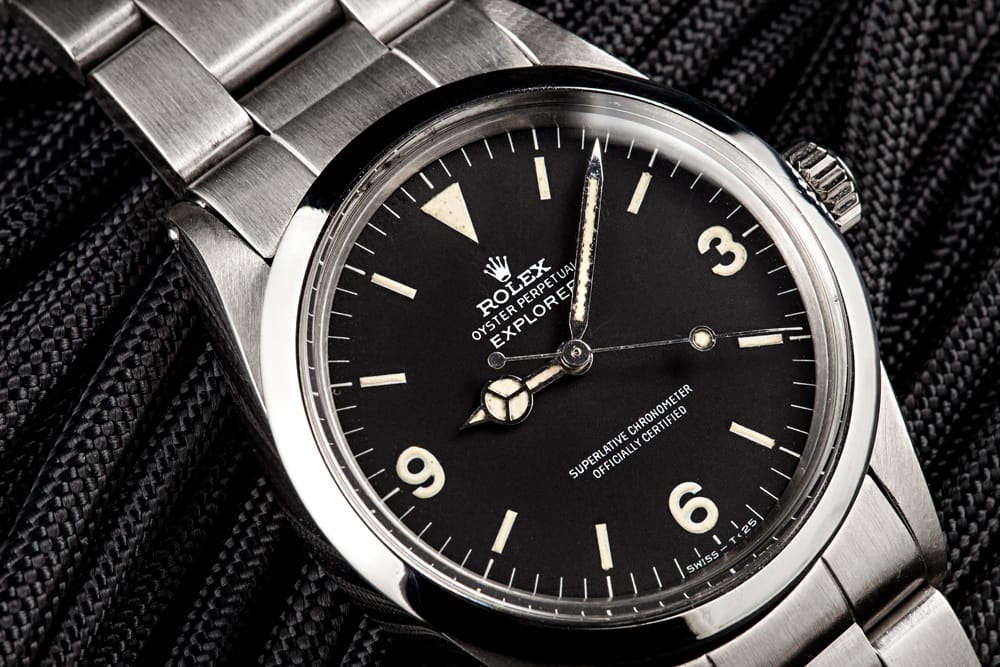
Rolex Explorer ref. 1016
First introduced in 1963, the Explorer. Ref.
1016 had an incredibly long production run until 1989. With its
introduction came a new caliber — the Caliber 1560 — and increased water
resistance to 100m. In the mid 1970s the ref. 1016's movement was replaced with the Caliber 1570, which included the hacking feature.
The hacking feature meant that the seconds hand stopped when the crown
was pulled out all the way for more precise time setting. Other improvements to the Explorer ref.
1016 over its over 25-year manufacturing run included solid links to
the Oyster bracelet and the use of tritium rather than radium for the
watch's luminous accents.
Rolex Explorer ref. 14270
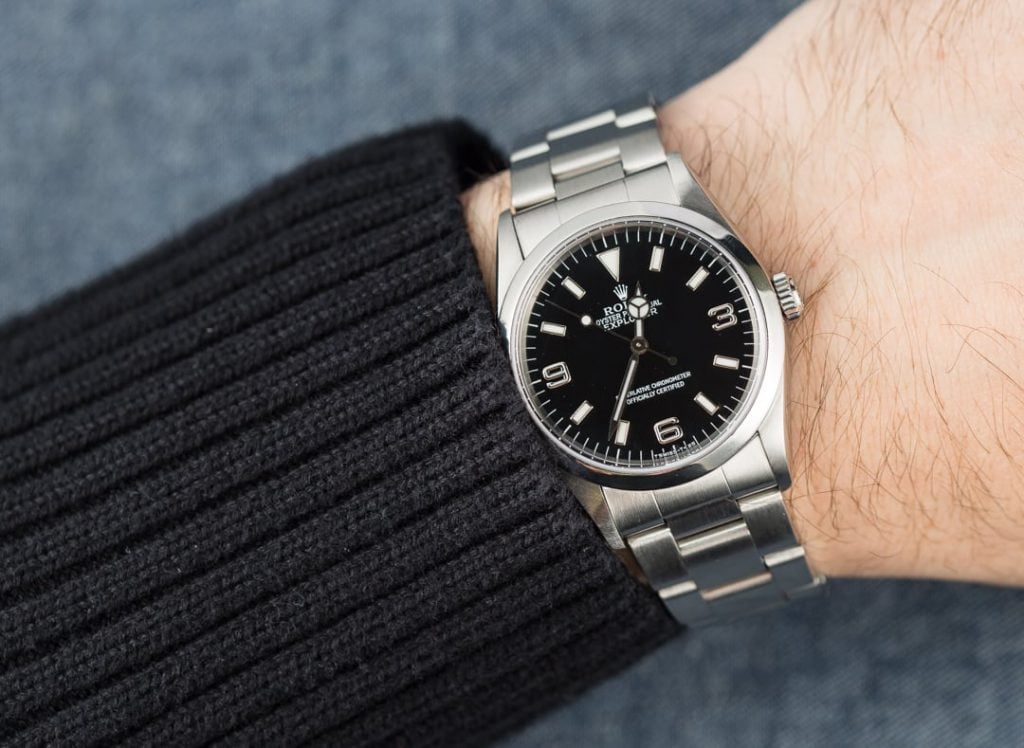
Rolex Explorer ref. 14270
The debut of the Rolex Explorer ref. 14270
at the end of the 1980s brought some significant changes to the
Explorer line including replacing the previous acrylic crystal with
scratch proof sapphire crystal and opting for a lacquered dial rather
than a matte one. Furthermore, the dial took on a much more modern approach with the applied indexes with 18k white gold surrounds. Powering the ref. 14270 is the Caliber 3000 and both the reference and caliber were replaced in 2001 with the ref. 114270 equipped with the Caliber 3130 in 2001.
Rolex Explorer ref. 214270
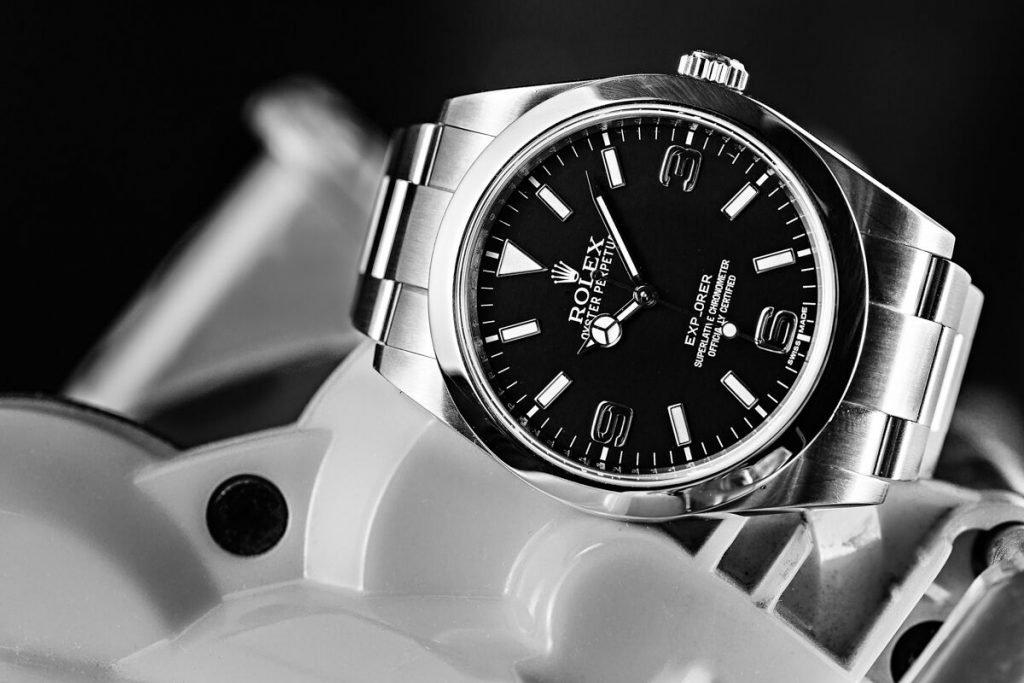
Rolex Explorer ref. 214270
The most current reference of the Rolex Explorer is the ref. 214270 that was first unveiled in 2010. This particular Explorer ushered in the biggest change to date — the increase in size. The ref. Explorer ref. 214270 sports a 39mm Oyster case instead of the traditional 36mm, which is more in line with today's demand for larger watches.
Also new to the modern-day Explorer was the addition of the Caliber
3132. Aside from the body and engine updates, the face was also given a
lift.
The characteristic 3, 6, and 9 numerals are no longer luminescent since
they are entirely fashioned from 18k white gold and the “EXPLORER”
label moved from below 12 o'clock to above 6 o'clock.
Interestingly, Rolex received quite a bit of backlash for the new
design, specifically that the minute hand was much too short for the new
size of the Explorer. So six years later, in 2016, Rolex revamped the ref. 214270 to give it better proportioned center hands, as well as making the 3, 6, and 9 numerals luminescent again. Since there are two distinct versions of the Explorer ref. 214270, perhaps they should be referred to as “Mark I” and “Mark II” dials to avoid confusion.
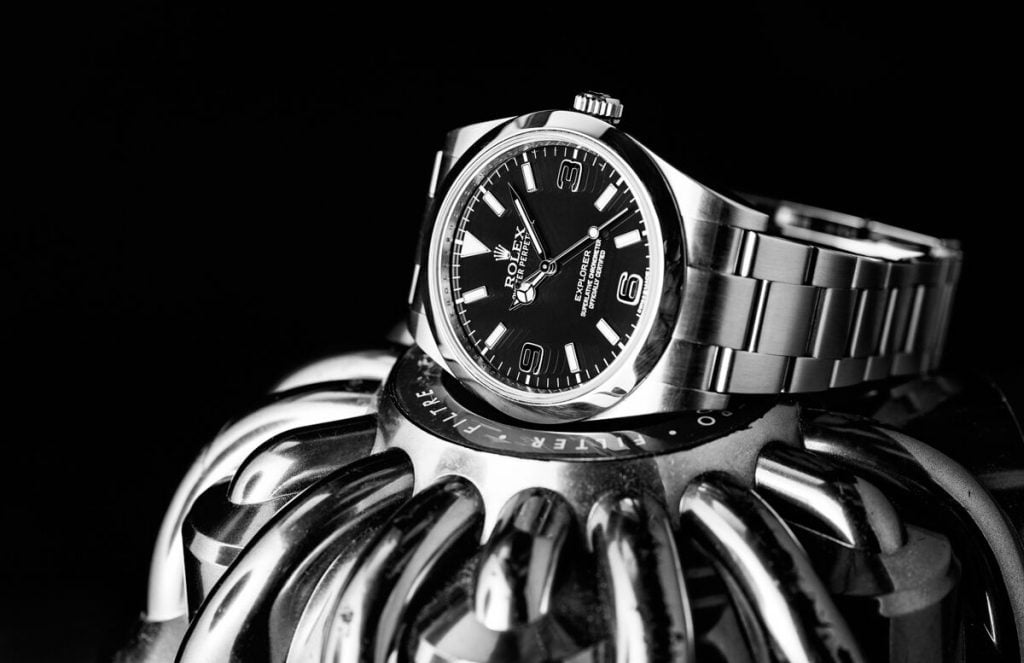
Rolex Explorer ref. 214270
Looking at these four key references of the Rolex Explorer that spanned
five decades gives a clear design and technical evolution of the
brand's most discreet sports watch.
Although the most contemporary version of the Explorer is
unquestionably modern and sleek, it still bears the fundamental
aesthetics of its vintage ancestors. And that is something that Rolex has perfected — evolution rather than revolution.
vedere di piu falso rolex e Chopard Grand Prix De Monaco Historique

Nessun commento:
Posta un commento